by Rachel Harris, WEDO Advocacy Coordinator– Originally posted Aug. 24, 2012, Daily Kos Climate Change Blogathon
The direct and indirect effects of climate change continue to have a disproportionate impact on marginalized women, including refugee and displaced persons, sexual minorities, religious and ethnic minorities, adolescent girls, women and girls with disabilities and those who are HIV positive… our goal is to empower women who are particularly vulnerable to climate change and to encourage a more gender-sensitive approach in climate change policy- U.S. Congresswoman Barbara Lee
From New Orleans to Bangladesh, those with the fewest resources are the most susceptible to climate change’s negative effects, particularly women. In many parts of the world, women still face unequal access to decision-making, formal financial systems, land ownership, reproductive health care and education and information, undermining their well being in addition to that of their families and communities. At the same time, women’s vulnerability can obscure the fact that they are capable, with the right tools and resources, of coping with climate change and reducing the emissions that cause it. As innovators, organizers, leaders, educators and caregivers, women are positioned to help curb the harmful consequences of a changing climate. Incorporating gender equality into climate change policies, projects and funds is crucial in ensuring that women contribute to and benefit from equitable climate solutions.
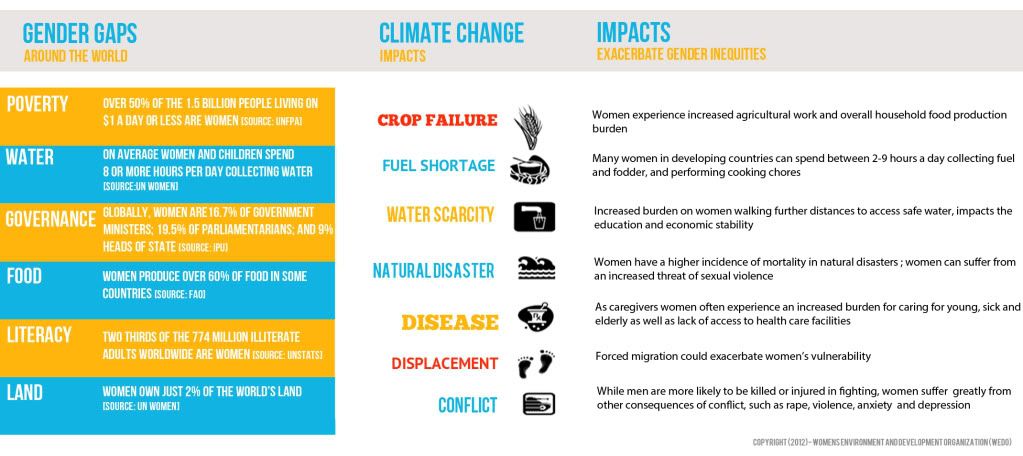
Around the world the integral links between gender equality and climate change impacts can be seen clearly. The graph below highlights some global gender gaps and the impacts of climate change:
Women’s Leadership on Climate Change
Women’s leadership in all levels of decision-making on climate change is also critical to addressing climate change comprehensively. So far, much of the climate change debate is spearheaded by men; women are only 12% of those that lead the global climate policy negotiations. Diversity in leadership and decision-making ensures that policies and legislation can best address the diverse needs and capacities of those most impacted by and able to combat climate change. It is imperative that women, half of the world’s population, are equitably represented in climate change decision-making at all levels.
In the U.S., even while there has been much progress for women’s civil rights there are still vast inequalities. Of the 535 seats in the current U.S. Congress, only 90 (16.8%) of those seats are held by women. Women are still only paid $0.77 to every $1 a man is paid for doing the same job. As witnessed recently with the attacks on reproductive rights, women’s rights are still negotiable in political debates. At the same time, women in the U.S. are challenging these obstacles. Women are gaining economic status, now as the owners of 40% of America’s privately owned businesses and holding half the country’s wealth. In boardrooms of Fortune 500 companies, in non-profit and grassroots organizations, on university campuses and across social media platforms, women are challenging their place in the pipeline, questioning the nature of power and mobilizing for change.
U.S. women can use the rights they do have to vote for and be the responsible leaders that uphold women’s rights and ensure a healthy and safe environment. U.S. Congresswoman Barbara Lee who wanted to recognize and address the disparate impact of climate change on women and the efforts of women globally to address this issue spearheaded 2 resolutions in Congress to address women and climate change impacts in 2009 and 2011. Like Congresswoman Lee, women and men must continue advocate for the U.S., still the largest per capita contributor to climate change impacts and one of the most important global actors on climate change policies, to take actions nationally and globally that combat the most imminent threat to the planet and its people in the 21st century.
——————————————
Further information on the linkages between gender and climate change can be found in the WEDO/UNFPA resource kit on gender and climate change, Climate Change Connections and the Global Gender and Climate Alliance (GGCA) training manual on Gender and Climate Change.
For more on WEDO’s work, visit WEDO’s website and follow us on Twitter(@WEDO_Worldwide) and Facebook.


