
Data Brief
Jun 8, 2023Women’s participation in climate and environmental decision-making is a human right, and leads to stronger environmental outcomes. Yet, progress toward gender balance in UNFCCC spaces has not been consistent or significant.
Stay Informed
Receive updates on our progress, thinking, and strategies as we advocate for gender-just climate, environment, and economic policies around the world.
Download the report in
Women’s participation in climate and environmental decision-making is a human right, and leads to stronger environmental outcomes. Yet, progress toward gender balance in UNFCCC spaces has not been consistent or significant.
It’s been just over 10 years since the Parties to the United Nations Framework Convention on Climate Change (UNFCCC) committed in 2012 to striving for gender balance in their delegations to the climate negotiations and in other decision-making bodies, and this year will be the 10th Conference of the Parties (COP) since that COP18 goal.
Women’s participation in climate and environmental decision-making is a human right. Women’s participation is not only crucial (and has been proven) to create more robust, stronger environmental outcomes, but also must be inherent in decision-making processes to fulfill this right. Tracking women’s participation in the Conference of Parties, the supreme decision-making body of the United Nations Framework Convention on Climate Change (UNFCCC), as well as the subsidiary body meetings (such as the Bonn Climate Change Conference), enables us to identify and address persisting inequalities.
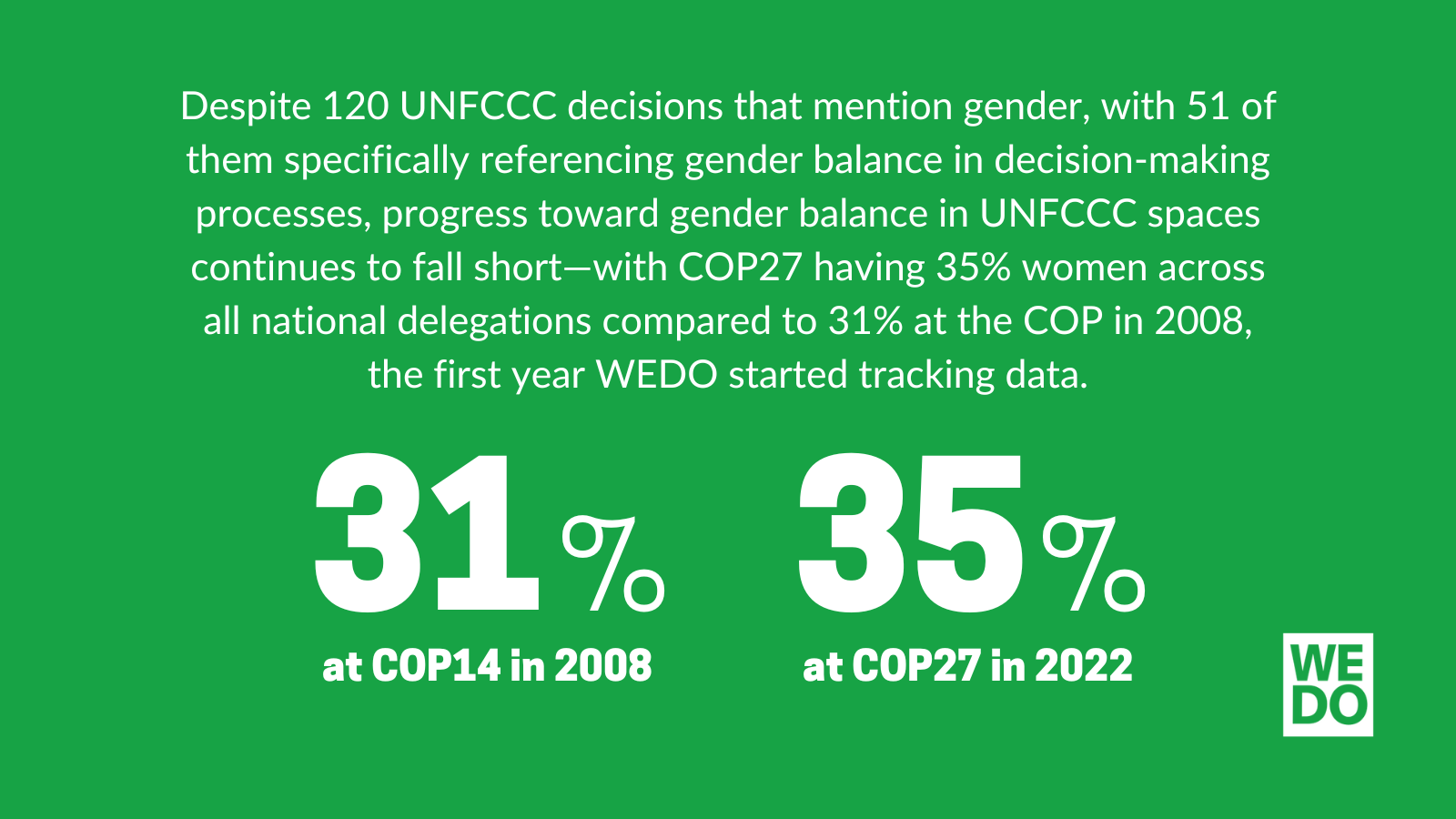
In 2008, the first year that the GCT collected data on Party delegations to the negotiations disaggregated by sex, COP14 had 31% women’s participation and 82% of Party delegations had more men than women. The latest data from 2022 shows that at COP27, 35% of Party delegates were women — a less than 5 percentage point improvement. 77% of Party delegations still had more men than women. Parties are bringing thousands more delegates to participate in the negotiations, but they are not bringing more women; as a whole, Parties are not prioritizing gender balance in their delegations.
In the negotiations, participation trends suggest that women tend to gain power in spaces where decision-making is deemed less pivotal and/or where countries prioritize the participation of Ministerial level delegates. (At the Bonn Climate Change Conference, a smaller UNFCCC intersessional meeting, there is a consistently greater proportion of women than the COPs held within the same year.) In the UNFCCC constituted bodies, it appears that a key variable is the topic that the body covers, as areas such as adaptation have consistently strong women’s participation rates, while technology, mitigation, and finance-focused bodies continue to see significantly lower numbers.
There are 198 Parties to the UNFCCC, and Parties’ individual histories of gender balance vary widely–on the GCT app or website, each Party’s history can be viewed. Africa and Asia tend to have lower women’s participation (with 30% and 31% respectively for COP27), while Europe and Others, Latin America and the Caribbean, and Oceania tend to have higher participation rates (with 45%, 41% and 46% respectively for COP27).
The “full, equal and meaningful participation” of women requires not only achieving gender balance among delegations, but also guaranteeing women have the same place of power in any climate negotiations, including as leaders. Women are less likely to be in positions of power than they are to participate in any delegation or body, and case studies of sex-disaggregated speaking time (not tracked consistently) show that women are often, but not always, less represented during the negotiations.
Resources

Support Our Work
Your donation provides us with the stable foundation we need to build the feminist future we’re working to realize.
Donate Today


