
Data Brief
Jun 9, 2022Throughout the past several years of the international climate change negotiations, alongside the establishment of a new sustainable development agenda, governments across the world have agreed that promoting gender equality and protecting women’s human rights are necessary to meet global climate and development goals. Parties to the UNFCCC have emphasized the importance of women’s leadership […]
Stay Informed
Receive updates on our progress, thinking, and strategies as we advocate for gender-just climate, environment, and economic policies around the world.
Throughout the past several years of the international climate change negotiations, alongside the establishment of a new sustainable development agenda, governments across the world have agreed that promoting gender equality and protecting women’s human rights are necessary to meet global climate and development goals.
Parties to the UNFCCC have emphasized the importance of women’s leadership in climate change policymaking across several key decisions, including under the gender action plan (GAP). While we have seen many great initiatives to enhance women’s participation, from travel funds to mentorship networks, progress remains uneven and unacceptably slow.
Since 2009, as a part of ongoing efforts to enhance women’s voice and leadership in climate change policy-making, the Women’s Environment and Development Organization (WEDO) has tracked the participation of women delegates on national delegations to the UNFCCC—across countries, regions and as Heads of Delegations. We have documented and shared these statistics on the Gender Climate Tracker website and mobile app, and produce regular briefs on the status of these figures.
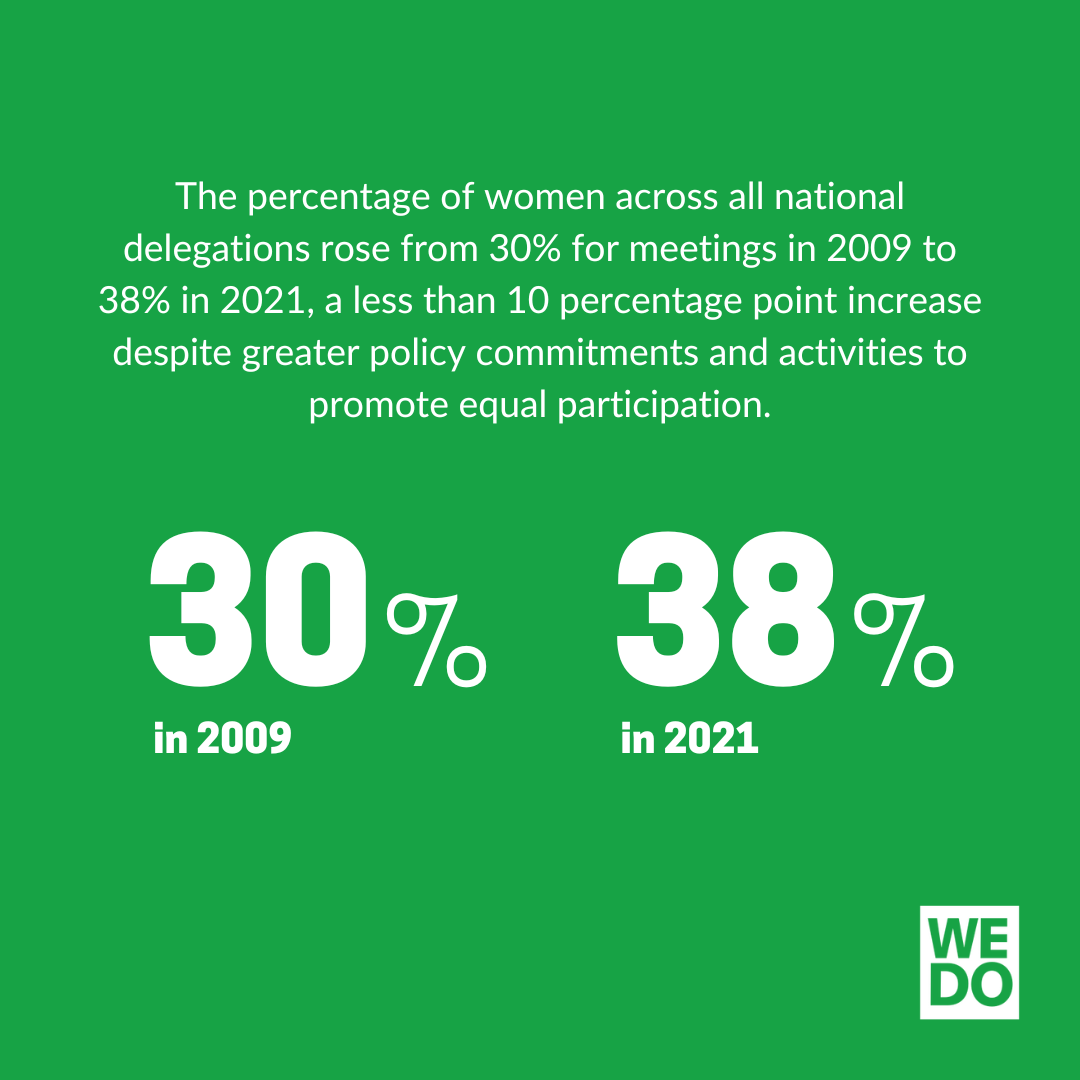 The percentage of women across all national delegations rose from 30% for meetings in 2009 to 38% in 2021, a less than 10 percentage point increase despite greater policy commitments and activities to promote equal participation.
For COPs, only 10% of Heads of Delegations were women in 2009 and 13% in 2021, with a low of 9% in 2015 and high of 26% in 2017. Arguably, COP15 in 2009 and COP21 in 2015 were considered pivotal decisionmaking events under the UNFCCC, highlighting that as more senior officials take up the role as Head of Delegation, the more likely they are to be men.
Women’s participation tends to be highest in delegations from Latin America, Eastern Europe, and Western Europe, often between 45% and 50%, and lowest in Africa and Asia, often between 30% and 35%.
At this rate of change, gender parity in national COP delegations will not be achieved until 2040, and gender parity in COP Heads of Delegations will not be achieved within the forecastable future.
Resources

Support Our Work
Your donation provides us with the stable foundation we need to build the feminist future we’re working to realize.
Donate Today


