

join the movement
Women and girls around the world are demanding and creating systemic change and a sustainable future for all. We need collective power to attain a just future – we need you.

By Shereen Talaat, MENAFem Movement, with contributions from Katie Tobin, WEDO
The Fourth International Conference on Financing for Development (FFD4), held in Seville in June 2025, ended without advancing a fairer, more just global financial system. The outcome text ignored the demands of feminists, Global South governments, grassroots organizers, and civil society. Instead, it upheld the same architecture that drives inequality, climate collapse, and debt dependency.
Feminist movements, including MENAFEM and WEDO, participated throughout the process. We spoke clearly. We proposed alternatives. We were heard but not listened to.
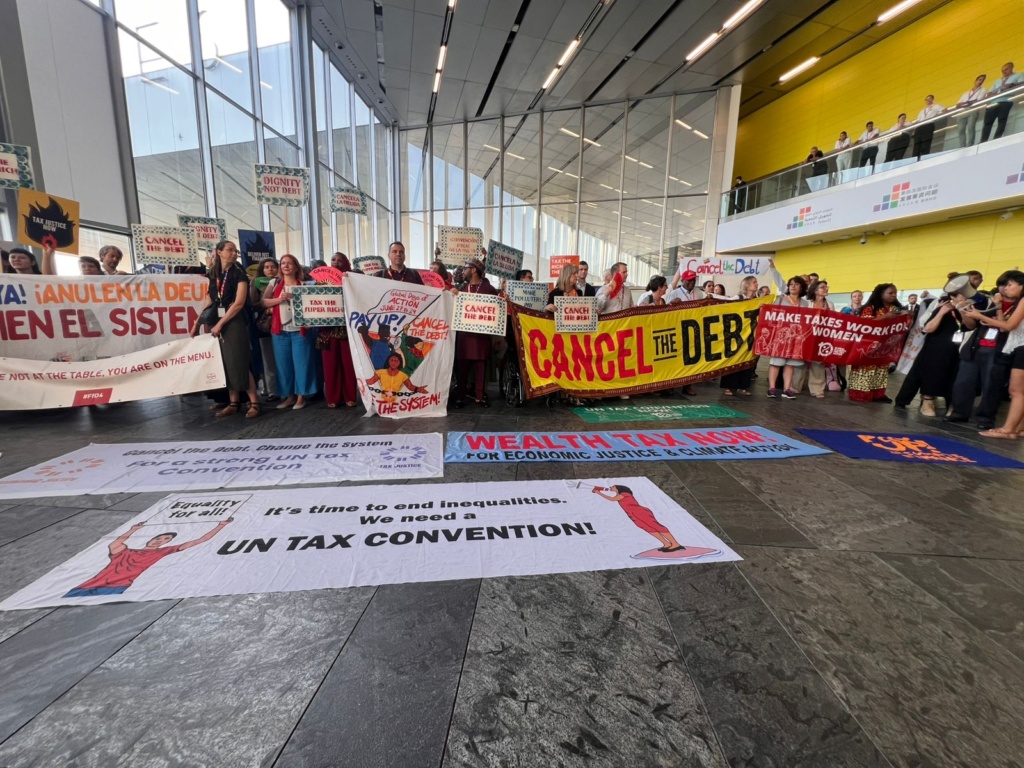
Photo: MENAFem
Feminist Proposals Left on the Table
Feminist demands at FFD4 were grounded in lived realities and supported by evidence. Building from the analysis and collective advocacy of feminists from the Global Majority, they included:
None of these made it into the final outcome. The text reflected old, debunked priorities: an overreliance on private finance, a continued insistence on the magic of public-private partnerships, and vague language on sustainability without binding commitments.
Debt Crisis Is a Feminist Issue
Across the MENA region, debt burdens are growing fast:
These countries are not alone. Over 50 developing countries now spend more on external debt service than on social services. And for the most climate-vulnerable countries, things are only getting worse: in 2024, they paid four times more on external debt payments than they did in 2010.
Women pay the highest cost.
Cuts to food subsidies, fuel, and social programs hit low-income women first. Care responsibilities grow while state services shrink. Informal labor expands. Violence increases in crisis-affected areas.
Yet the FFD4 document failed to call for debt cancellation. It offered no roadmap for systemic debt resolution under a neutral body like the UN. Instead, it reinforced creditor-led mechanisms, ignoring power asymmetries.
Greenwashing Old Problems: Debt-for-Climate Swaps
In Seville, the World Bank and Spain launched a new “Debt Swap Hub” to scale up debt-for-climate swaps. These swaps are promoted as innovative, but their record tells a different story:
This is not climate justice. It’s a new form of conditionality dressed in climate language.
Real climate finance must be new, additional, grant-based, and guided by local priorities — not used to repackage or prolong unsustainable debts.
Austerity Is Still the Default
Despite years of evidence that austerity deepens inequality, the FFD4 outcome reaffirmed the language of fiscal consolidation and “sound macroeconomic management.” This is coded language for cuts to public spending.
Oxfam’s 2023 research showed that 85% of IMF loans between 2020 and 2023 required austerity. In MENA, this means:
These measures directly undercut gender equality. They force women and feminized people to absorb the shock through unpaid labor.
The care economy was mentioned at FFD4 but not funded. There was no new financing for childcare systems, elder care, or health infrastructure.
Feminists have said it for years: care is not a footnote. It is the foundation of any economy.
Climate Finance: Still Insufficient, Still Unfair
The $100 billion annual climate finance target was not met by its deadline of 2020, nor was it replaced with a figure that adequately represents the scale of climate need–or of rich countries’ obligations. Most climate finance continues to be issued in the form of loans, not grants. Less than 2% is gender-responsive. Less than 10% reaches grassroots organizations.
At FFD4, there was no binding commitment to increase grant-based climate finance. No recognition of historical responsibility. No agreement to operationalize Loss and Damage financing outside loan mechanisms.
For communities on the frontlines of climate collapse — especially in water-stressed, food-insecure parts of North Africa — this is not a policy gap. It is a matter of survival.
What We’re Building Instead
MENAFEM, WEDO, and other feminist movements across the South are not waiting. Building from a convening in Rabat, Morocco in May of this year, we are:
We reject the dominance of creditor countries over decision-making. We reject the use of “market-based solutions” that deepen inequality and extraction.
We demand a financing system that works for people and the planet.
Feminists Will Not Be Silenced
Despite the disappointing outcome of FFD4, feminist analysis, advocacy, and organizing were strong. We showed that economic policy is not gender-neutral. That fiscal policy choices are life-or-death issues for women and marginalized communities. That global rules must change.
We will take this work forward — to COP30, to the UN Tax Convention negotiations, to the next World Bank and IMF meetings, and beyond.
Feminists in the Global South are not calling for reform at the margins. We are calling for transformation. A new economic system based on care, justice, and ecological balance — not debt, extraction, and austerity.
 Women’s Environment
& Development Organization